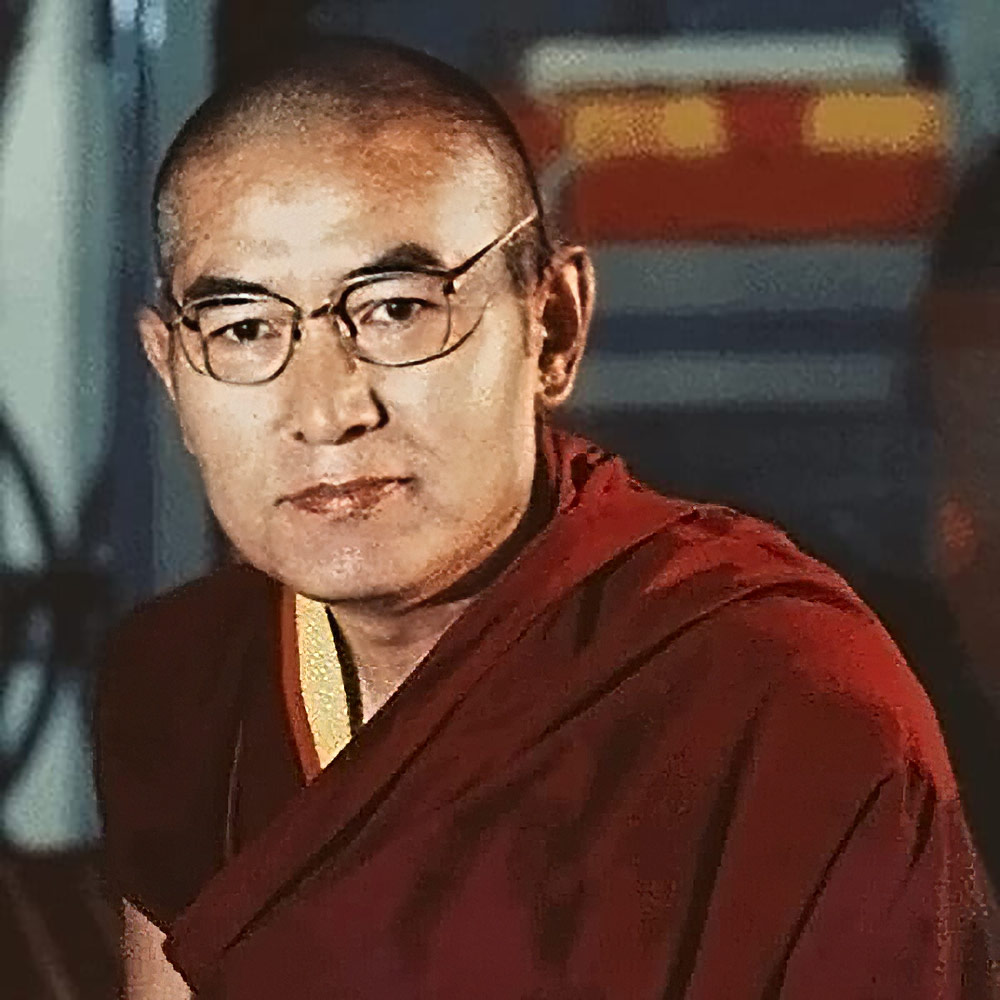
His Holiness Drikung Kyabgön Chungtsang
His Holiness Drikung Kyabgön Chungtsang
His Holiness the Drikung Kyabgön Chungtsang, the 36th throne holder of the Drikung Kagyu lineage and the 8th reincarnation of the Chungtsang Rinpoche, is a manifestation of Manjushri.
The Drikung Kyabgön Chungtsang, Tenzin Chokyi Nangwa, was born in the water-horse year 1942 in Lhokha as the youngest of five sons into the prominent aristocratic Lhagyari family. His father was Trichen Kelsang Nyendrak and his mother Rigzin Chodzom. The Lhagyari family is one of the oldest noble houses of Tibet and descends from the ancient royal dynasty. The family branch is called Dewa Lhagyari Trichen.
After the early death of the 7th Chungtsang Rinpoche, Tenzin Chökyi Jungne (1909-1940), the youngest son of the Lhagyari family was recognized in 1946 as the reincarnation of the Chungtsang Rinpoche and enthroned at the Drikung Thil monastery. There were many signs, prophecies and consultations of oracles confirming his reincarnation. Gyabra Tritsab had a vision at Lake Lhamo Latso, which was corroborated by further prophecies of H.H. the 16th Karmapa and of H.H. Taklung Matrul. The Tibetan government also certified the reincarnation, and Chungtsang passed the traditional test of selecting religious objects that had belonged to previous reincarnations.
At the age of eight, he began to learn to read and write, to memorize texts and to perform rites and rituals. His most important spiritual teacher (yongzin) was initially Gar Khensur Tsangyang Norbu Rinpoche, and from 1955 Tritsab Gyabra Rinpoche and Ayang Thubten Rinpoche. He received transmissions, empowerments and teachings of the Kagyu tradition and the Drikung Kagyu tradition, in particular from Tritsab Gyabra, Ayang Thubten, Lho Bongtrul Rinpoche and other important lamas.
In 1959, after the Tibetan uprising, Chungtsang Rinpoche had to undergo communist indoctrination and harsh struggle sessions at the Nyima Changra shedra, where the Chinese army had set up its regional headquarters. He was severely mistreated and in December 1959 he was put in prison. Chungtsang Rinpoche remained imprisoned for 23 years, until 1982. Especially during the period of the Cultural Revolution, he had to go through harsh re-education programs and perform forced labor. During this time, he was transferred to the notorious prison camp Kongpo Ningtri. There he had to fell trees in the forests. One day he was struck by a falling tree and severely injured. It was said that he only survived because he was the Kyabgön Rinpoche.
In the course of the political liberalization of 1983 in China, he was finally released from prison and received a post in the Regional People's Congress and subsequently a senior position in the department for religious affairs of the Tibet Autonomous Region.
In 1985, Chungtsang Rinpoche was allowed to travel to India for the first time to meet his brothers who had left the country. He also visited the Drikung monasteries in Ladakh and met Chetsang Rinpoche there again after 26 years. The second time he was allowed to travel abroad was in 1992. Chungtsang Rinpoche came to Dehradun for the inauguration of the Jangchubling monastery of the Drikung Kagyu Institute. As it was a monkey year, he gave the traditional monkey-year teachings together with Chetsang Rinpoche. For the Drikungpa, the sun and the moon had finally been reunited. At that time, Chungtsang Rinpoche was promoted to deputy secretary-general of the bureau for religious affairs in Lhasa, an office he holds to this day.